
A Generation in Crisis: 2025/26's Absence Figures Paint Bleak Picture


The Department for Education released their absence figures for the autumn term 2025/26, and the picture they paint is a clear sign of the crisis we face.
After a peak in the autumn of 2022/23, absence figures had been gradually falling. Slowly, and often frustratingly so, but falling nonetheless.
Now, for the first time since that high, the figures have increased across the board.
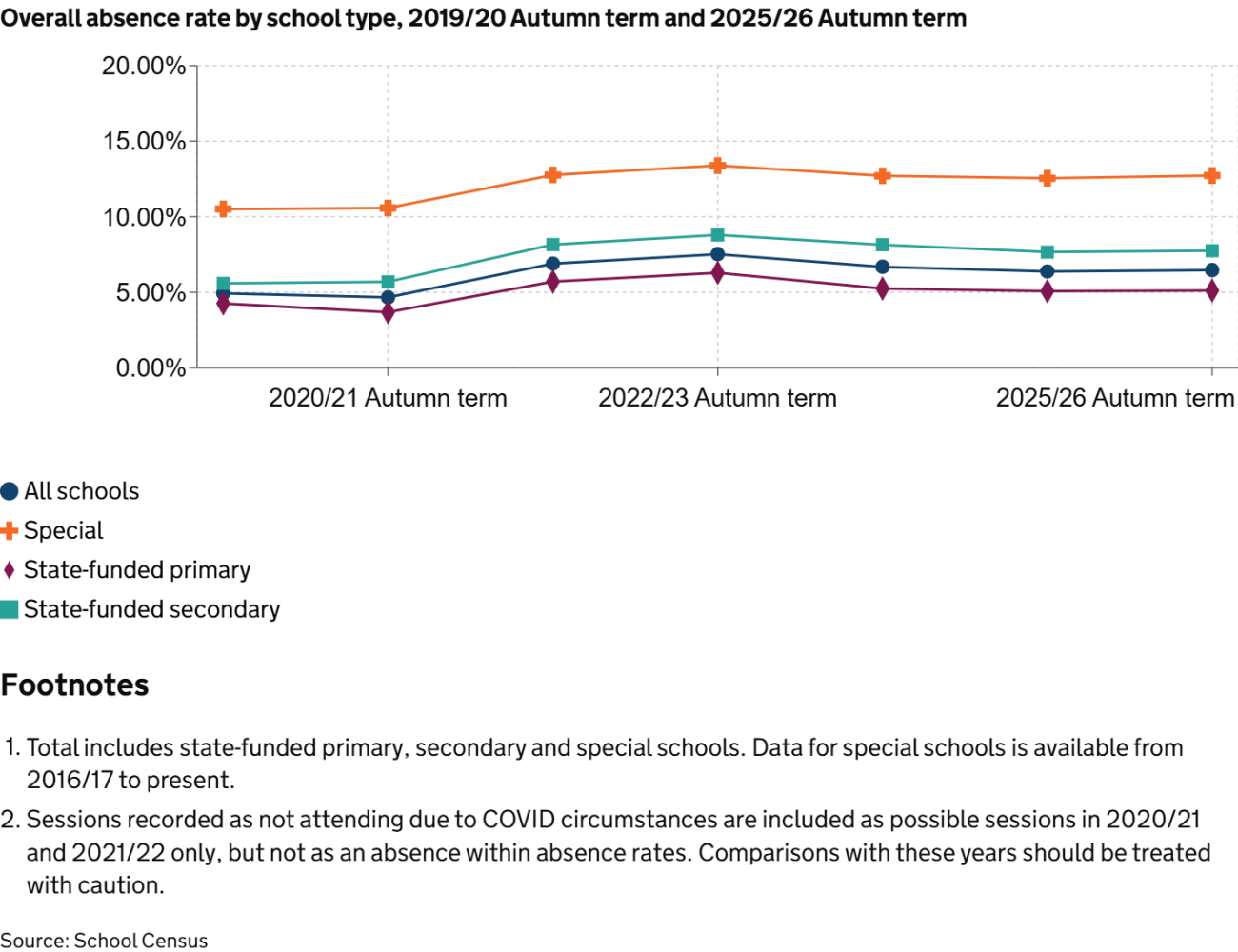
In primary schools from 5.07% to 5.12%.
In secondary schools from 7.66% to 7.75%.
In special schools from 12.55% to 12.73%.
All of this comes to an overall absence rate of 6.47%, up from 6.38% in the previous year and still well above the pre-COVID levels of less than 5%.
This now means that there are 1.29 million pupils persistently absent (missing 10% or more of school) from school in England, up from 1.28 last year, and 151,000 severely absent pupils (missing 50% or more of school), up from 148,000 last year.
The only real improvement in absence rates came in specifically for severely absent students in secondary schools, which fell just 0.03% from 3.19% to 3.16%. However, the persistent absence rate in secondary schools increased 0.44% from 21.09% to 21.53%, suggesting that while some students have managed to return to the classroom more often than not, attendance is still a struggle.
This, of course, fits with everything we have learned at MVA over the past 5 years.
Time and time again, we encounter children who have been partially or entirely absent from school for months or years - and it is never because the child does not want to learn, or engage, or because the parents don't care.
It is because school had become impossible, and was making the child miserable, or unwell.
And this is also clear in the data, with illness by far being the most common reason for absences at 3.37%, an increase on both last year and the pre-pandemic levels.
But, while these numbers are alarming, they aren't new.
Absence and sickness rates have remained high since the pandemic, despite concerted efforts from successive governments to bring students back into the classroom. Efforts that, clearly, have not worked. Because the pandemic did not just disrupt the mainstream school system, it also highlighted its most serious flaws, and showed families up and down the country that an alternative approach was not only possible, it was immediately life-changing.
MVA, in some part, owes its creation to the haphazard emergency measures schools were forced to put together as lockdowns began to hit in 2020. Because even those most basic of online provisions were, for a significant minority of children, enough to completely transform school from something they dreaded to something they loved.
It was parents of those children who turned to Minerva Tutors (now MVA Tutors) asking for some kind of full-time model, and MVA was born.
In the years since, MVA has proven over and over again that persistently absent children are not absent by choice. They are absent because the physical school experience becomes impossible. And you cannot overcome impossible by force.
In the words of MVA Founder Hugh Viney:
You cannot force a child to go to a school that makes them sick, and then expect them to succeed. It doesn’t work. It’s short sighted, it’s self-defeating, and (most importantly) it’s cruel.
The numbers are clear. The genie is out of the bottle, and things are not just going to 'go back to normal'. It's time to start listening to students and parents about what they need from school instead of insisting that one size fits all.
That one size fits most. And that's okay. But we have to provide for everyone.


.png)


